

Abdominal wall surgery: see all conditions and techniques
Medical information: Dr Pablo Aragó Chofre, specialist in General and Digestive Surgery. Read about his professional background.
Laparoscopic inguinal hernia surgery reinforces the groin from behind through small incisions. The TEP and TAPP techniques and robotic rTAPP repair offer different ways of reaching the preperitoneal space, where the mesh is placed. Understanding their differences helps you understand the operation and prepare for recovery.
The surgical technique is chosen individually, taking into account the hernia, your health and your previous medical and surgical history. During your consultation, we agree on a treatment plan and explain its benefits, risks and recovery.
On this page: TEP, TAPP and rTAPP · Bilateral and recurrent hernias · Recovery · Request an assessment
Recognising a hernia and confirming the diagnosis
The lump usually becomes more noticeable when you cough or strain and may disappear when you lie down. If it goes back in, this does not mean the defect has closed: the contents return to the abdomen, but the opening remains. Some hernias cause discomfort without an obvious lump.
An examination is usually enough to confirm an obvious hernia. Ultrasound may help when there is pain without a clearly defined lump or uncertainty about its cause. The other groin is also examined, and a femoral hernia is distinguished from an inguinal hernia. A femoral hernia lies in a nearby area but has a different risk of complications.
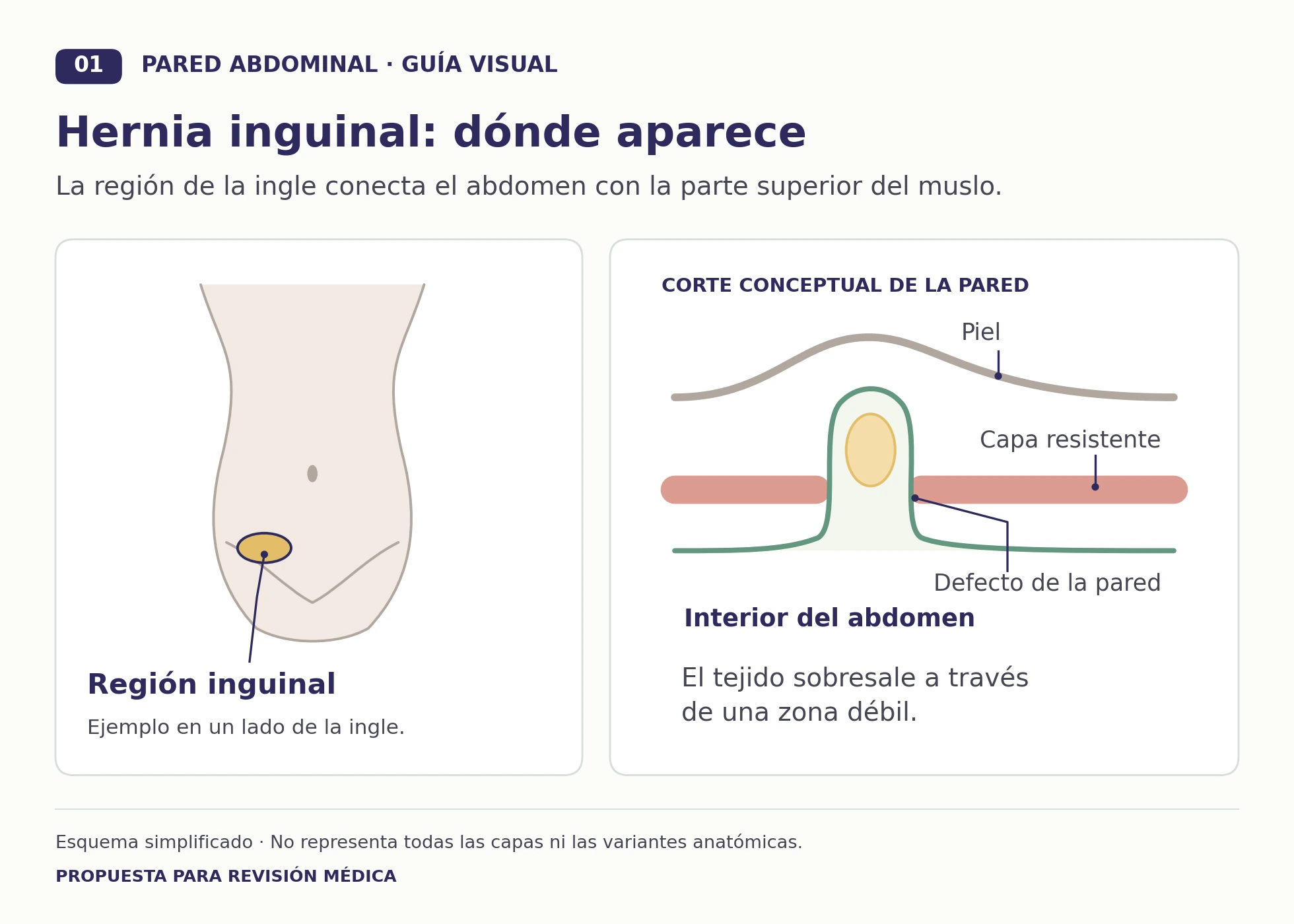
Enlarge the inguinal hernia diagram.
When to operate and when watchful waiting is possible
A planned repair is considered when a hernia causes pain, limits activity or makes work difficult. For men with an inguinal hernia that causes no symptoms or only minimal discomfort, watchful waiting is an alternative: it avoids an immediate operation, but it does not cure the hernia, and many patients eventually need surgery when symptoms develop.
Watchful waiting does not apply in the same way to a femoral hernia or a groin hernia in a woman. In these situations, it is especially important to rule out a femoral component and consider repair without unnecessary delay.
Minimally invasive surgery: TEP, TAPP and rTAPP
Compared with an open approach, laparo-endoscopic techniques are associated with faster recovery and a lower risk of chronic pain when performed with appropriate training and resources. TEP and TAPP place the mesh in the same anatomical plane and have comparable outcomes; the main difference is how that plane is reached.
TEP: access from outside the peritoneal cavity
The repair uses a camera and small incisions to create a space between the abdominal wall and the parietal peritoneum, the membrane lining the inner surface of the abdominal wall. The mesh is unfolded in this preperitoneal space to cover the weak points of the groin. The usual route of access does not pass through the cavity containing the intestines.
TAPP: access from inside the abdomen
The abdominal cavity is entered laparoscopically and the peritoneum is opened to reach the same preperitoneal repair plane. Once the mesh has been placed, the peritoneum is closed over it, separating it from the abdominal organs. The main difference from TEP is the route of entry; both reinforce the groin from behind.
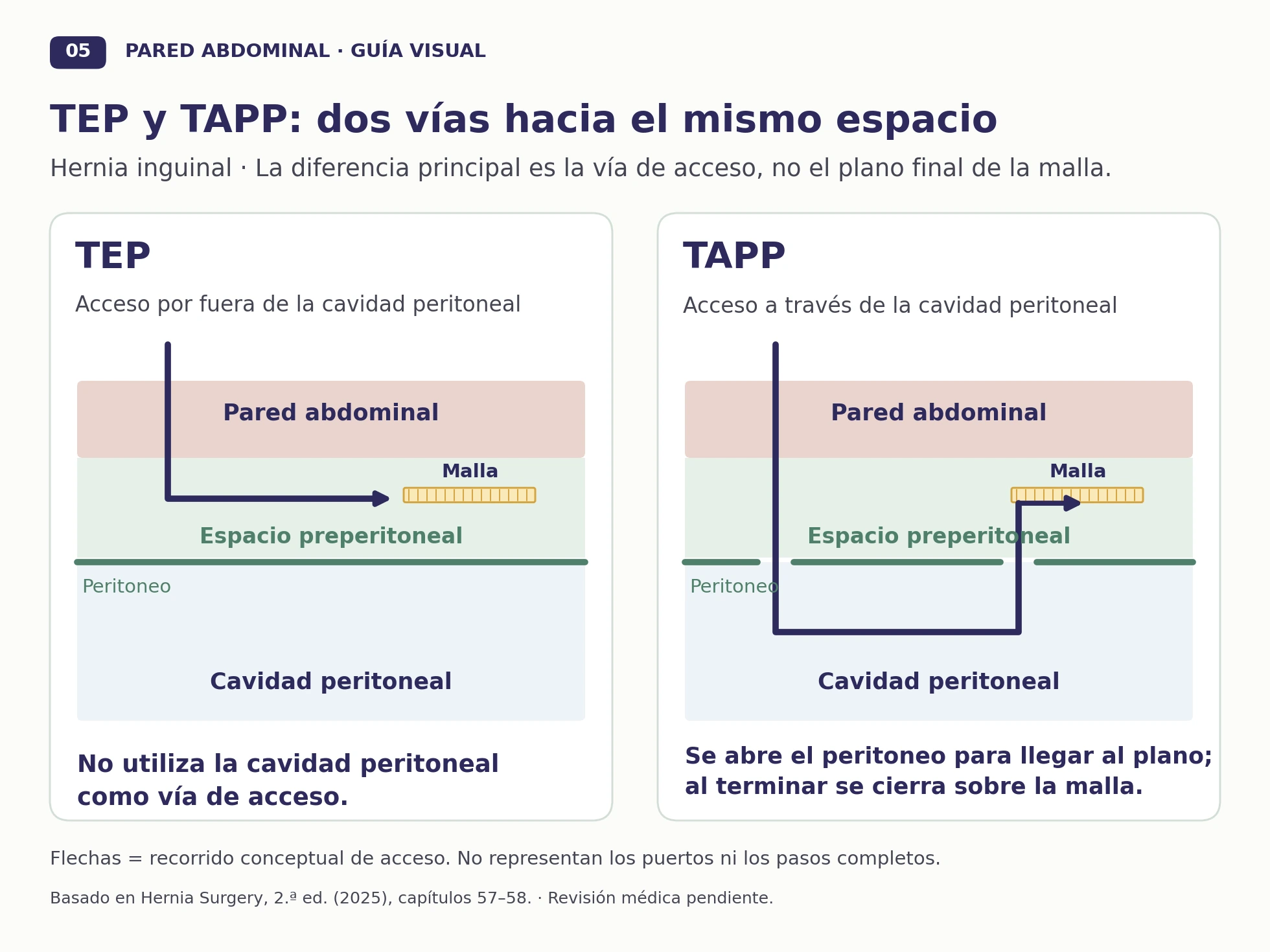
Enlarge the comparison of TEP and TAPP.
rTAPP: TAPP repair with robotic assistance
This follows the steps of TAPP using articulated instruments controlled by the surgeon from a console. Robotic assistance helps with dissection and suturing; it does not in itself change the aim of the repair or guarantee better outcomes than laparoscopy. Availability is confirmed when the operation is planned.
Lichtenstein: the open alternative
Through an incision in the groin, the hernia is identified and the wall of the inguinal canal is reinforced with mesh. This is an open approach that does not require entry into the abdomen. Because nerves lie close to the repair, identifying and protecting them during surgery is important.
Hernias in both groins and hernias that come back
For a bilateral hernia, TEP and TAPP allow both groins to be repaired through the same small incisions. This is one reason why involvement of both sides affects surgical planning.
If a hernia has returned, it is essential to know how the previous operation was performed. After an open anterior repair, a posterior approach is usually considered; after a posterior repair, an anterior approach is considered. Working in a different plane may avoid some of the scar tissue. The previous operation report and details of any mesh used are particularly helpful.
What the mesh does
The mesh covers the defect and reinforces a wider area of the groin. It is commonly used in adult repairs because it reduces recurrence compared with many repairs based on stitches alone. Alternatives without mesh exist, but they are not equivalent for every hernia. During the consultation, we explain the proposed repair and its risks, including persistent pain.
Preparing for surgery and recovery
Before surgery, your medical conditions, medicines and anaesthesia are reviewed. If you take anticoagulants or antiplatelet medicines, your team must give you specific instructions: do not stop them yourself. Arrange for someone to accompany you when you leave hospital, and plan the first few days carefully if your work involves driving or heavy lifting.
After the operation, walking and a gradual return to everyday activities are encouraged. You may feel tightness or develop swelling or a haematoma in the groin; the way your pain changes and the condition of the wound help guide recovery. Returning to an office job does not involve the same physical effort as heavy lifting or strenuous sport.
Increasing pain, fever, wound discharge or difficulty passing urine require medical advice. As well as early complications, the risk of persistent groin pain and the possibility of recurrence should be discussed.
Symptoms that need emergency care
If the lump becomes hard and very painful, no longer goes back in, or you develop vomiting, abdominal swelling or changes in skin colour, seek emergency care. Do not try to force it back in or wait for an online reply.
Inguinal hernia assessment in Valencia
During your consultation, we will review the symptoms caused by the hernia, whether one or both groins are affected, and which aspects of your medical or surgical history influence the repair. If you have had surgery before, bring the operation report. Read about Dr Pablo Aragó's professional background.
Request an appointment at your preferred IMED centre: Valencia (Burjassot), Colón or Gandía. In the booking portal, select Cirugía General y del Aparato Digestivo (General and Digestive Surgery) and Dr Pablo Aragó Chofre. If you need help or cannot find his appointments, see the telephone numbers and locations of the three centres.
The button opens IMED's external booking service, which has its own terms and privacy policy. Your appointment is subject to confirmation by the centre. Do not use this channel for emergencies.
More about abdominal wall surgery: Abdominal wall surgery · Incisional hernias and hernias in a surgical scar
Medical sources
HerniaSurge 2023 update. This information provides general guidance and does not replace an individual consultation.
Anatomical basis of the diagrams: Novitsky YW (ed.), Hernia Surgery: Current Principles, 2nd edition, 2025. Original illustrations based on the book; they do not reproduce its figures.